
5 Things We Bet You Didn’t Know About Greenland Sharks!

Author: Caitlyn Cooke
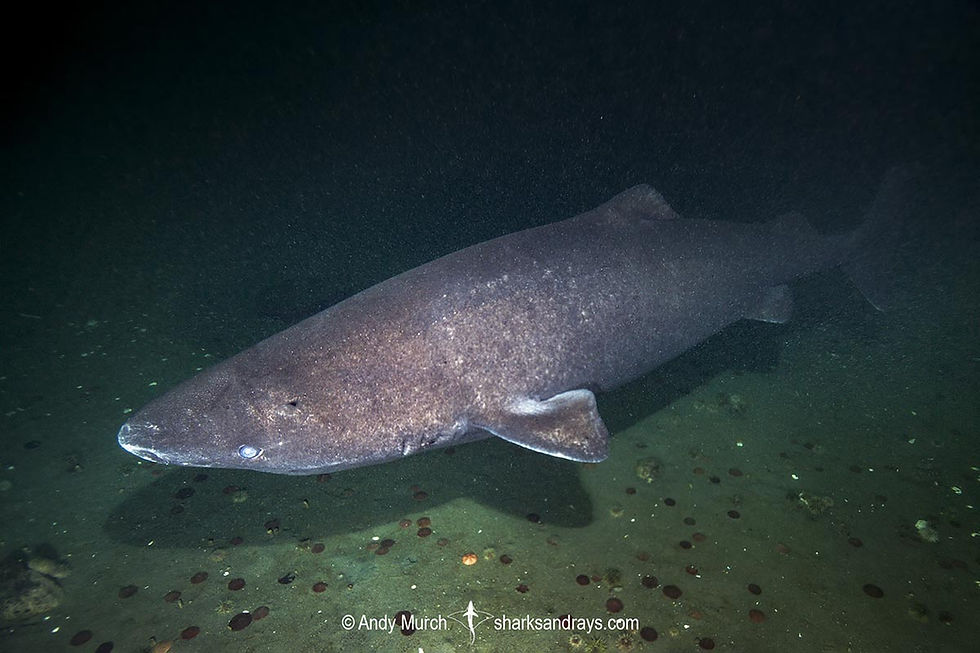
1. Greenland sharks can live anywhere from 250 years to 500 years (and maybe even longer)! Many marine organisms have unique features that allow scientists to determine their age. For many sharks, scientists use fin spines or shark vertebrates. However, Greenland sharks are quite unique; they don’t have either of these features. So how have scientists developed this estimate? Well, they have used a technique called carbon dating. Certain proteins are formed in shark’s eyes at birth, and they never degrade. Scientists can use these proteins to then estimate how old a shark could be. Determining the lifespan of these sharks is constantly evolving as scientists are working to find more accurate ways to predict their age.
2. Greenland sharks have a copepod parasite that attaches to their eye. Ommatokoita elongata, is the official name of this copepod parasite. It can lead to lesions, which as with any other organism, impacts the sight of the shark. However, there is some speculation that this parasite could help sharks with hunting in deep, cold waters where they typically reside. It’s believed that this parasite can experience bioluminescence, drawing in prey for the shark. Therefore, it’s possible that this parasite is engaging in a mutualistic relationship where the parasite is benefited by the shark and the shark is benefited by the aid in hunting for prey.

3. Greenland sharks are considered sleeper sharks. Greenland sharks are a part of the family Somniosidae, which are commonly referred to as sleeper sharks. Sharks in this family often experience sluggish behaviour. Greenland sharks, in particular, are noted for having swimming speeds of 1.8 miles per hour and typically grow by less than a centimeter in a year. Also, these sharks have to be at least a century old in order to mate with others.
4. Greenland sharks can be anywhere from 8-24 feet long. Most sharks tend to be 4 feet long, but Greenland sharks can be up to 6 times bigger than this size. While it’s not the biggest shark in the ocean, it’s significantly larger than most species. It may be hard to imagine this size but think of a camper van. That’s quite the size for a shark! Since they live for so long, however, this does make sense. Their growth of roughly 1 centimeter per year for centuries definitely contributes to their size.
5. Greenland sharks live in waters with temperatures from 34-68 degrees Fahrenheit. Greenland sharks are commonly found in the northern hemisphere, particularly the Northern Atlantic and Arctic regions. However, some have been found in areas off the coast of Cape Cod. They live in relatively deep waters, up to 3,937 feet deep. To survive in these cold deep waters, Greenland sharks store certain chemicals, called urea and trimethylamine oxide.These chemicals allow the shark to store heat and protect it from these freezing temperatures.

Thanks to Andy Murch for use of his Greenland shark photos.
Sources:
Bowling, T. (2020, December 21). Arctic Sharks. Florida Program for Shark Research. https://www.floridamuseum.ufl.edu/sharks/blog/arctic-sharks/
Greenland Shark - Somniosus Microcephalus. Shark Research Institute. (n.d.). https://www.sharks.org/greenland-shark-somniosus-microcephalus
Greenland Shark. Florida Museum. (n.d.). https://www.floridamuseum.ufl.edu/discover-fish/species-profiles/greenland-shark/
Greenland Sharks: Old, cold and fascinating. Save Our Seas Foundation. (n.d.). https://saveourseas.com/worldofsharks/podcast/greenland-sharks-old-cold-and-fascinating
How long do greenland sharks live?. NOAA’s National Ocean Service. (n.d.). https://oceanservice.noaa.gov/facts/greenland-shark.html


